
The world sees the title, the strategy, and the results. But what often goes unsaid in the executive journey is the fundamental internal transition required to sustain that level of leadership. The transition isn’t just a bump up in pay; it’s a profound shift in self-management—a commitment to building a Personal Operating Model as rigorously as you build or play that pivotal leadership role in a company.
Even as I write this, I realize the things I don’t do and the lack of perfection on my end. But just acknowledging this frees me from the burden of truth, allowing me to share what I have learned so far and what I am learning going forward.
When I transitioned into my first executive role at GE, I was more enamored with the title and the promotion but very underprepared for what was about to hit me. It didn’t register until someone saw me at the mall over the weekend with my family and asked, “Aren’t you the guy who signed up for that job? Why would you do that?” To me, it was just another day, another fire. I soon realized, however, that a deep personal restructuring had to occur for me to be successful.
While we had leadership training, much of what I learned was about the facade of being a leader. There was no program that taught me the brass tacks of how to manage the transition itself.
When you step into an executive role, the challenge isn’t the sheer volume of work—it’s the weight of accountability and the overwhelming pressure to be “always on.” The quiet truth is, this space can feel profoundly lonely. You need a system—a personal architecture of clarity—that not only supports you, the person, but scales your ability to lead the entire organization.
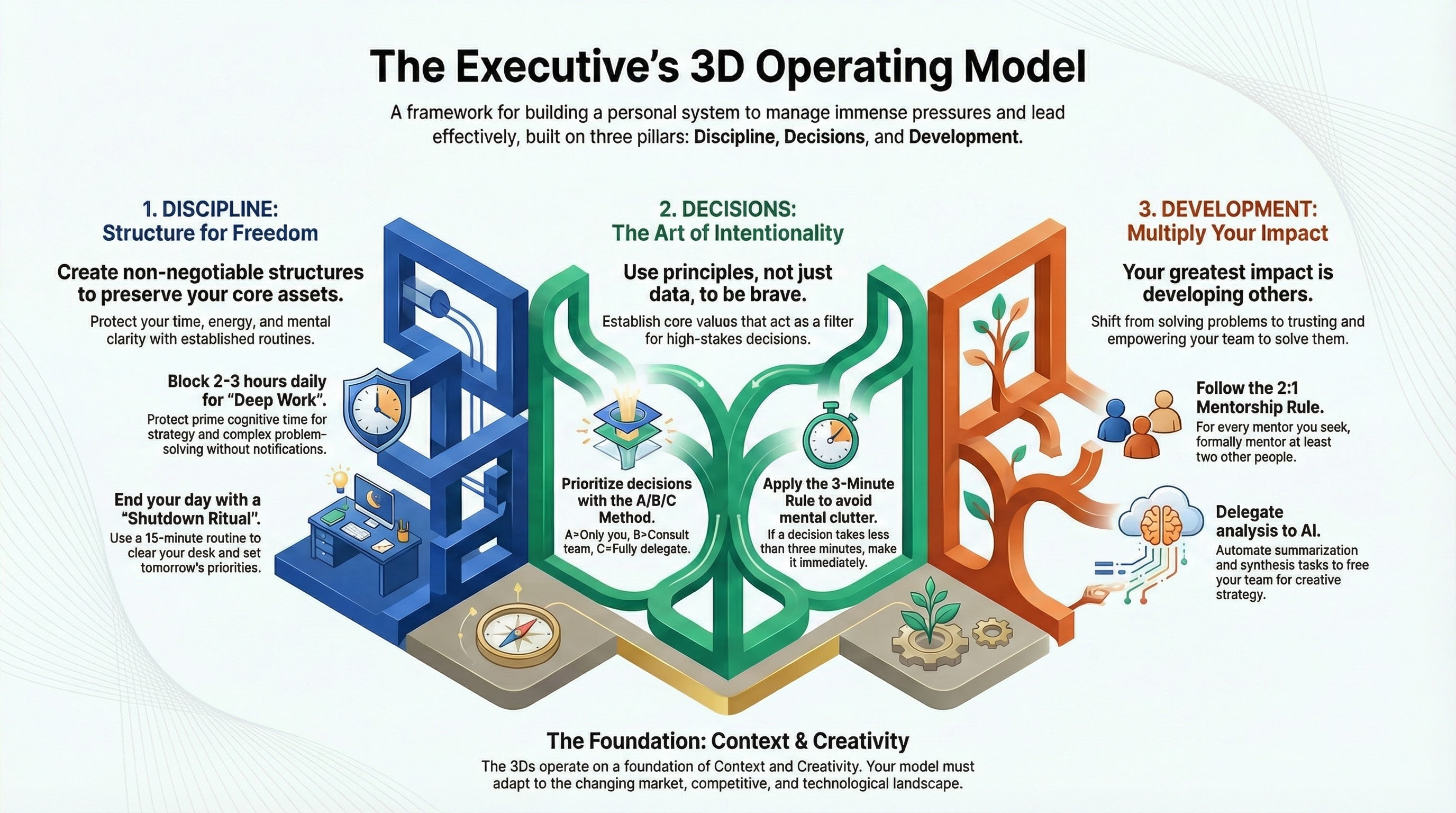
A successful executive operating model isn’t a rigid schedule; it’s a self-optimizing framework that directs your energy, protects your focus, and accelerates your growth. Over time, I’ve distilled this framework into The 3Ds: Discipline, Decisions, and Development.
This model occurs within a critical foundation of Context and Creativity, ensuring your efforts are relevant, adaptive, and innovative. When the Context changes—as it did for me moving from GE to Kraft Heinz to McKinsey—a full reset of the model is required.
1. ⚙️ Discipline: Structure That Fuels Freedom
Discipline is not about constraint; it is about creating non-negotiable structures that preserve your most precious assets: time, energy, and mental clarity.
What I wish someone told me: When you skip your routine for ‘just one deadline,’ you’re trading weeks of sustained capacity for a few hours of stressed output.
Core Disciplines:
Health and Wellness: The foundation of sustained, high-level performance. Treat physical and mental health as capacity building, not a cost. You cannot pour from an empty or depleted vessel. The 30 minutes of exercise, 15 minutes of meditation, or even walking meetings—whatever it is, commit to it.
Food Discipline: Yes, this is a thing. I never order noodles with clients, avoid opening my mouth big for a burger bite, skip slurpy food, limit carb or sugar-heavy meals, and always keep my stomach half-empty at lunch. Food needs to fuel your mental stamina, not dull it. (Acknowledge your personal choice to prioritize mental clarity through specific food rules).
Calendar and Routines: Use your calendar as a defensive tool against noise and distraction. I reserve Saturdays for family, start my work rhythm on Sunday afternoon, and use late nights or early mornings for focused work. I schedule flight times before or after work days to zone for dedicated work. You must define your own routine.
The Deep Work Block: Protect 2-3 hours of prime cognitive time daily for strategy, complex problem-solving, and critical thinking. Silence all notifications.
Actionable Tips for Discipline:
Audit Your Calendar: Review the last two weeks. What meetings were purely informational? Convert them to asynchronous updates to reclaim time.
The ‘Shutdown’ Ritual: Create a 15-minute routine: clear your desk, write the top three priorities for tomorrow, and close all open tabs. This physically and mentally signals the end of work.
Micro-Recovery: Integrate short, mindful breaks (e.g., 5 minutes of stretching or focused breathing) every 90 minutes to reset cognitive fatigue.
2. 🎯 Decisions: The Art of Intentionality
In the executive seat, every choice ripples outward. Your operating model must be built to optimize how and where you spend your finite decision-making capacity.
What I wish someone told me: The fear of making the ‘wrong’ decision never fully goes away. You need principles, not just data, to be brave.
Decision Domains:
Personal Decisions (The Boundary Rule): The biggest decisions are the ones you make with your spouse, parents, and children—from grocery runs to defining travel cadence and setting boundaries for family events. Every ‘Yes’ outside your core priorities requires a non-negotiable ‘No’ within your boundaries.
Work Decisions (The Principles Filter): Your decision-making requires principles. It is seldom about the decision itself and often about the principles that guided you to the decision. Focus your executive judgment on Level 1 and 2 issues with the right principles, and delegate the rest. Before a high-stakes meeting, name the single principle that will guide your final recommendation.
Prioritization Decisions (The Algorithm): Establish core, non-negotiable values (e.g., Transparency First, Value over Speed) that act as an internal algorithm for decision automation, allowing you to architect organizational clarity.
The 3-Minute Rule: If a work decision takes less than 3 minutes to resolve and doesn’t require deep contemplation, make it immediately to prevent mental clutter.
A/B/C Prioritization: Designate A as decisions only you can make, B as decisions your team can make with consultation, and C as full delegation.
3. 🚀 Development: Exponential Growth, Within Context
Leadership is a growth business. The greatest leaders don’t just develop themselves; they multiply their impact by developing the people around them. This process is deeply intertwined with Context and Creativity.
What I wish someone told me: Your greatest future impact lies not in solving problems, but in trusting others to solve them. Letting go is the hardest development task.
Development Focus Areas:
Self-Development (The Next 5% Rule): Structured learning focused on closing capability gaps or expanding into adjacent strategic domains. This might mean customizing news feeds, utilizing AI capabilities like NotebookLM, or curating answers for yourself. Identify the single skill or knowledge area that, if improved by just 5%, would yield the greatest professional return in the next quarter.
People Development (The Multiplier Mindset): Actively coaching, mentoring, and sponsoring high-potential talent.
Mandate “Think Time”: Encourage your teams to block time not just for doing work, but for thinking about how to optimize the work.
The 2:1 Mentorship: For every formal mentor you seek, formally mentor at least two others. This reinforces your knowledge and accelerates your team’s capabilities.
The AI Delegation Rule: Identify analysis, summarization, or synthesis tasks that currently consume high volumes of time. How many of those can be 80% automated or supported by Generative AI? This frees up your team—and you—for higher-order, human-only problem-solving and creative strategy.
The Role of Context and Creativity
Understanding the rapidly changing market, competitive, and technological landscape (Context) is essential to ensure your solutions and your team’s development are future-proof (Creativity). When I left GE, and then Kraft Heinz, and now at McKinsey, the context changed. Getting back to a winning formula requires re-adaptation.
The External Radar: Spend 1 hour weekly consuming content from outside your industry to identify emerging patterns and novel solutions.
Conclusion: The Human Behind the 3D System
This 3D Operating Model is not a prescription for a perfect executive. It’s an admission that the job is immensely difficult and requires intentional, daily structure. The goal is to move beyond the transactional—beyond merely hitting targets—and to focus on the transformational.
By intentionally structuring your Decisions, reinforcing your Discipline, and prioritizing continuous Development within the current market Context, you gain the freedom to lead with impact, empathy, and authenticity.
Start small: pick one actionable tip from each of the 3Ds and integrate it into your week starting tomorrow. The most successful executives are those who perfect their own internal operating system. This is the ultimate act of leadership, enabling you to step out of the daily churn and focus on architecting clarity, flow, and trust across the organization—the true work of the modern executive.
What single discipline are you committing to this week? Let me know in the comments below.