
Credit: Photo by Bernd 📷 Dittrich on Unsplash
Software development has always absorbed new paradigms: waterfall to agile, monoliths to microservices, on-prem to cloud-native. But the arrival of AI as a first-class participant in the SDLC is, quietly but unmistakably, a regime change.
While Silicon Valley touts stats of 20-30% of code being written by AI, and vendors upsell the dream of 60%, most of them ignore the factual realities of what it takes to make it work in an enterprise environment, the nuances of making it work in a greenfield vs. brownfield code repos, and in myriad of languages and architecture patterns.
“The bottleneck has moved. It’s no longer writing code. It’s reviewing it, governing it, and trusting it.”
The Engineering Reality Check
The most consistent pattern across industries is a massive gap between “AI works in a demo” and “AI works in our regulated, distributed, legacy-heavy environment.” That gap is Engineering Readiness, and it manifests in ten recurring failure modes:
Legacy debt and context gaps: AI models struggle with decades-old codebases and undocumented business logic. RAG pipelines help, but if your documentation is institutional knowledge, your AI will have to work harder.
The architecture paradox: We spent decades building for human readability. Now we must build for AI-interpretability. If your architecture is a spaghetti of dependencies, not modernized into Mermaid files, and a set of unmanaged confluence pages, agentic orchestration will struggle.
DevOps inconsistency In almost every enterprise, DevOps discipline is disparate. In one recent situation, the CI/CD structures were so rigid that even humans struggled to explain the rationale, code security reviews stuggled. AI cannot automate what is fundamentally broken.
Data management maturity: AI has unlocked the ability to generate test data instantly, but enterprise systems aren’t nimble enough to adopt or integrate this new speed. Further, the discussions are buried in Master Data readiness, lack of access to data as APIs, and more. Agents’ ability to connect, extract, review, and validate data is lacking.
Environment readiness: When every pod follows a different variation, Docker Compose locally vs. Traefik routing and/or cloud imposed security restrictions such as required HTTPS URL callbacks, AI agents hit a wall of environmental inconsistency.
Governance and accountability: SOX, GDPR, FDA. When an AI agent writes, reviews, and merges a change, who is accountable? Existing frameworks have no answer.
SaaS integration complexity:The average enterprise is a chaotic web of ERPs: SAP, Workday, o9, OMP, Salesforce, PowerBI, Databricks. AI struggles with this integration overhead.
Security and IP exposure: Where does proprietary code go? Who owns the output? Legal and InfoSec teams are often unprepared when pilots move to production.
Trust and hallucination risk: In finance and healthcare, a plausible-sounding but incorrect snippet can cascade into a production catastrophe.
The economic tipping point: Are you using AI to “save 20% on the dev bill” (Cost) or “reduce Time-to-Market by 70%” (Growth)? One is a race to the bottom. The other is market capture. Last but not least, are you replacing people cost with token cost? If yes, what is the balance?
Workforce Transformation: The Deepest Change
It is fascinating how many engineers remain “behind the 8-ball.” You hear everything from “I prompt and AI writes the code, doob doob doob,” to “Why use AI if I have to review it anyway?“ or even “I vibe-coded it yesterday.“ Leadership often thinks buying Cursor licenses is the solution, only to find the rest of the machine is stuck. The workforce equation is changing:
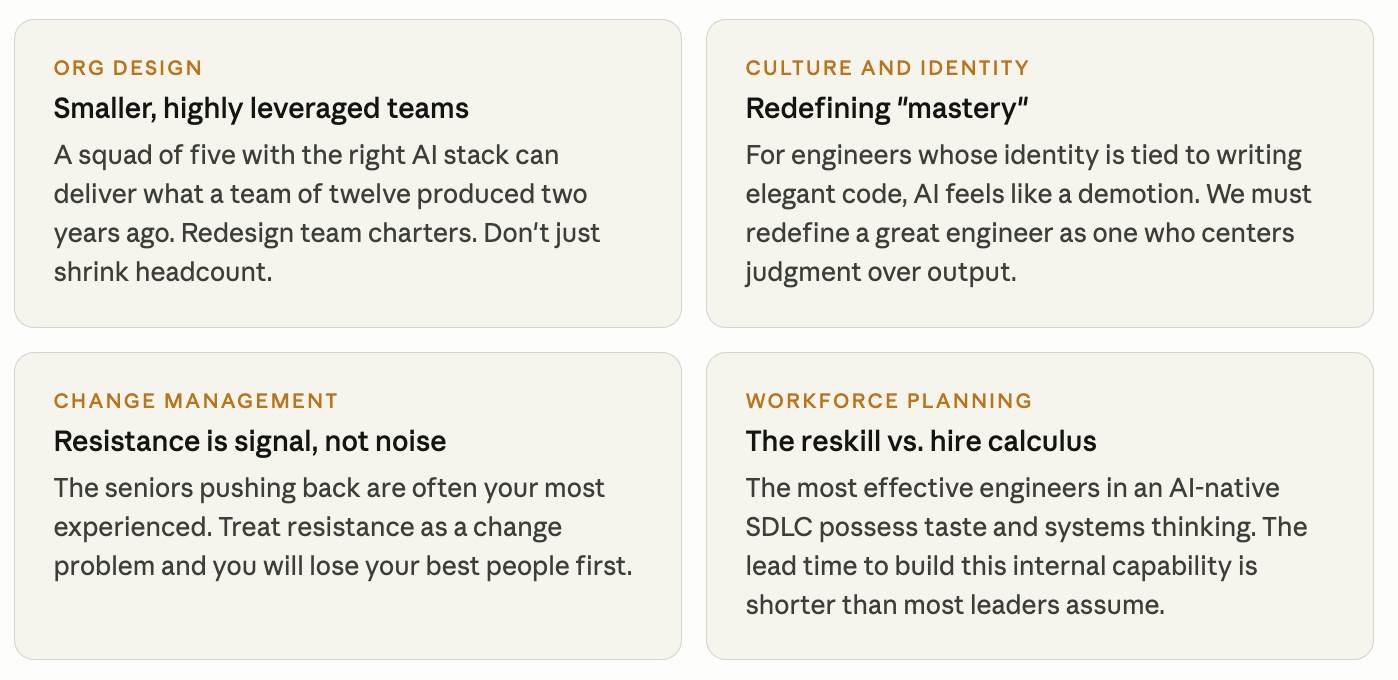
The vendor portfolio review you can no longer defer
Here is the dimension most transformation programs ignore entirely: AI has disrupted the economic logic that underpinned twenty years of outsourcing, offshoring, and vendor strategy. The labor arbitrage that made large SI engagements and GCC models attractive, headcount-based billing, time-and-materials contracts, cost-per-FTE comparisons, gets compressed fast when an AI-native team of five can outship a fifty-person managed services squad.
It is a live renegotiation happening right now, whether your procurement team is at the table or not. Your major SIs are repricing and repositioning their models in real time. The question is whether you are making deliberate choices or inheriting the terms they set.
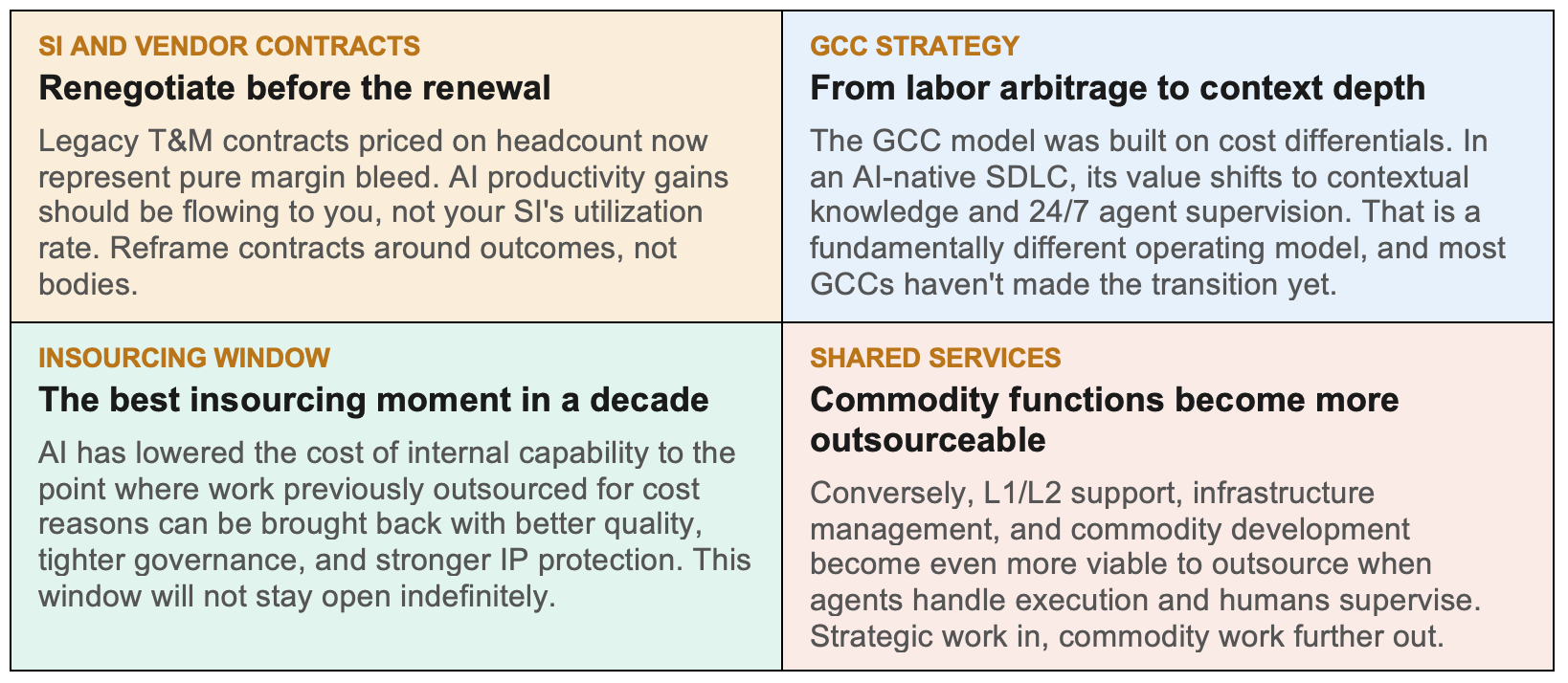
AI has forced a vendor portfolio review whether you asked for it or not. The leaders who treat this as a deliberate moment will reshape their cost structure and capability simultaneously. The ones who don’t will find their vendors have already adapted, to their own advantage
Ultimately, saying “I used AI” is moving from awkwardness to fashion, but it needs to become implicit. As one of my clients put it “AI is not something you go when you don’t know what to do. You go there first“. This requires restructuring incentives and career ladders to reward sharing prompts, rigorous AI output review, and the organizational judgment to decide what to build, what to buy, and what to let go.
New Roles Emerging Across the SDLC
The AI-powered SDLC is creating functions that didn’t exist 18 months ago, and remaking ones that did. For example:
AI Engineering Lead (Delivery): Owns the AI toolchain strategy; sits between platform engineering and delivery. The connective tissue the org currently lacks
Prompt / Context Engineer: Technical, platform-embedded roles that design retrieval pipelines and system prompts for enterprise codebases. Far more specialized than the title suggests
AI Quality and Validation Engineer: Bridges QA and ML engineering; builds eval frameworks to red-team AI-generated code. Critical in regulated industries, and increasingly everywhere else.
Developer Experience to AI DevEx Engineer: Owns the developer-AI interface: IDE integrations, feedback loops, context injection. The driver of sustained adoption across the engineering org.
SDLC AI Governance Lead: Owns audit trails and accountability frameworks for AI participation in software delivery. Mandatory in regulated industries. Increasingly mandatory everywhere.
Agile Coach to AI Delivery Coach: Redefines velocity, acceptance criteria, and retrospectives for human-AI teams. The ceremonies haven’t changed. Their meaning has.
Tooling: Reshaping the Stack:
The moat is no longer just generation quality. Every major player is converging there. The new differentiation is enterprise readiness: SSO, audit trails, fine-tuning on proprietary codebases, and RBAC. Evaluate accordingly.
Cursor and Claude Code: Massive disruptors allowing agents to work together to write code, shifting the paradigm from assistant to autonomous collaborator.
Claude Design / Figma: Integrating design across the coding ecosystem, closing the gap between spec and implementation.
Notion AI / Linear AI: AI-native planning tools bridging requirements to backlog items before a line is written.
Amazon Q Developer: Pushing concepts like spec-driven development: define intent first, generate implementation second
CodeRabbit / Sourcery: AI-native PR reviews that learn from your team’s history. Not just lint, but genuine intent evaluation.
Diffblue / Momentic: Automated unit testing and autonomous QA agents. End-to-end coverage without the bottleneck.
The Strategic Frame: The E.W.O. Framework
For CIOs and engineering leaders, the AI-powered SDLC demands a holistic redesign of the operating system of the firm. Not a tooling refresh. Not a training program. A fundamental re-architecture of how the enterprise builds software.
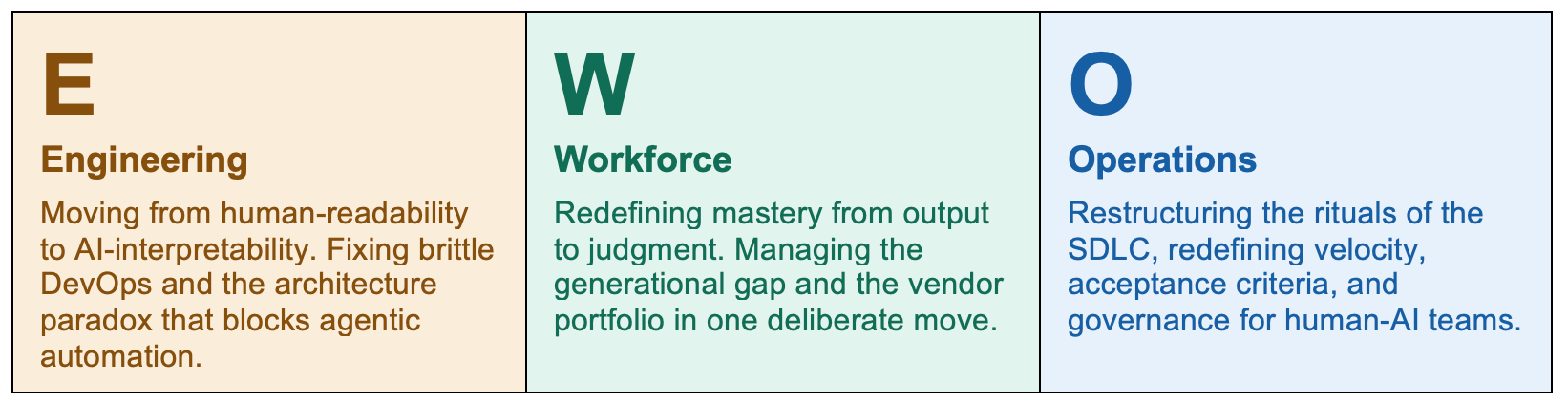
The AI-SDLC Maturity Index
Where does your organization sit today? The hard truth: most organizations think they are at Level 2 because they’ve distributed Cursor licenses. In reality, they are still stuck at Level 1 because their E.W.O., including their vendor strategy, hasn’t changed since 2019.
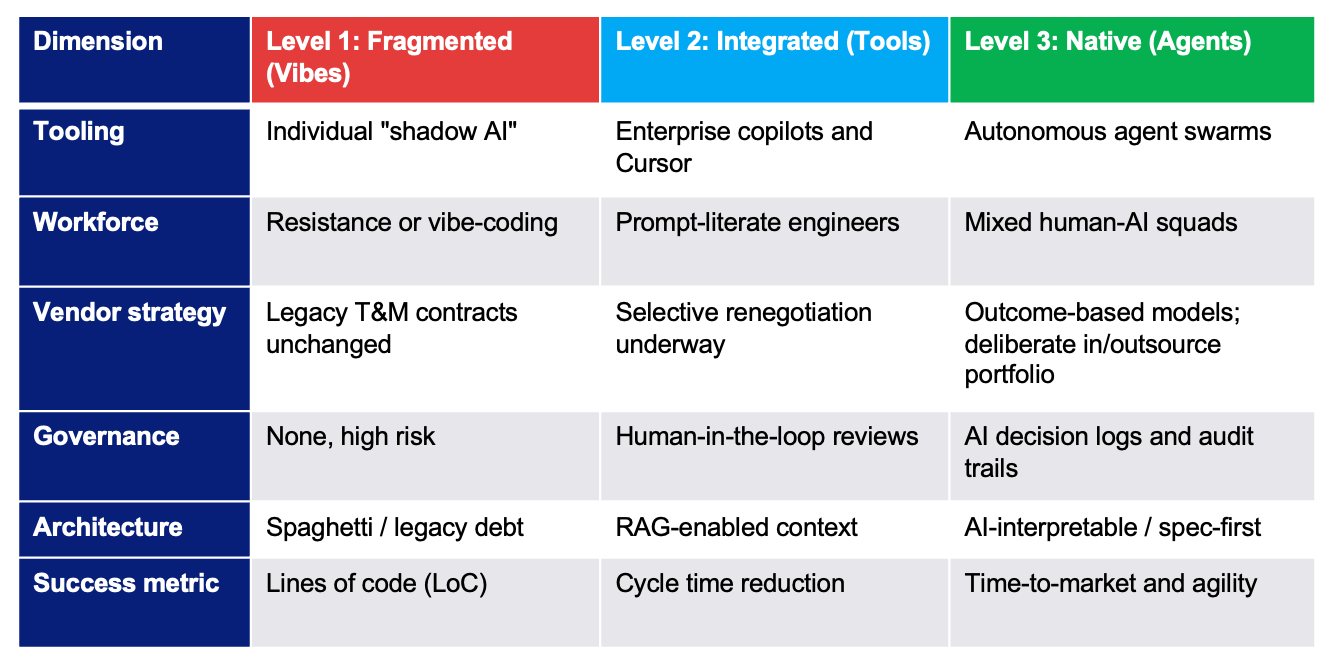
Where does your organization sit on this index?
Level 1: Fragmented (Vibes) | Level 2: Integrated (Tools) | Level 3: Native (Agents)
Drop your level in the comments, and whether your vendor strategy has kept pace. I read every response. If your org is navigating this transition and you want to compare notes, DM me. Or share this with a CTO or engineering leader who needs the honest version of this conversation.
P.S. Opinions, frameworks, maturity indexes are my own caused by Caffeine and Adrenalin and hands-on learnings from my day-to-day interactions.